Power Plant Confined Space Rescue Readiness in the Southeast Industrial Corridor
Power plant maintenance and outage work often requires personnel to enter tanks, vessels, boilers, and other restricted-access spaces where hazards can develop quickly and without warning. RIT Services, LLC provides confined space rescue standby for power plants throughout the Southeast Industrial Corridor, giving facility operators dedicated rescue readiness during permit-required confined space entries. Based in Rainsville, AL, our team works alongside plant safety personnel to support safer entry operations from pre-entry planning through task completion.
Confined space rescue standby for power plants is not a one-size-fits-all service. Every facility has its own layout, entry points, and hazard profile, which means rescue readiness has to be planned around the specific space and the specific work being performed. RIT Services, LLC Located at Rainsville, AL, our team approaches each project by evaluating the space, the scope of work, and the coordination needed with on-site personnel before entry ever begins.
What Confined Space Rescue Standby Services Involve
Confined space rescue standby services place trained rescue personnel on-site during entry operations so a response can begin immediately if conditions change. This differs from relying on offsite emergency responders, who may not arrive in time to address a rapidly developing situation inside a permit-required confined space. Industrial rescue standby services typically include pre-entry evaluations, atmospheric monitoring support, retrieval system setup, and continuous readiness for the duration of the entry.
For power plants, this type of standby support is often tied to planned outages, shutdowns, turnarounds, and maintenance projects that require workers to access boilers, condensers, cooling towers, ash pits, and other enclosed equipment. Because these projects often run on tight schedules with multiple crews working simultaneously, having a dedicated rescue team on standby allows plant safety personnel to focus on managing the broader project without diverting attention away from entry operations.
Why Power Plants Require Dedicated Confined Space Rescue Readiness
Power generation facilities contain a wide range of confined spaces, including tanks, vessels, boilers, pits, silos, vaults, and other restricted-access areas that present unique entry and exit challenges. These spaces are frequently associated with hazards that can escalate faster than personnel expect, which is why confined space rescue standby for power plants is often built into outage and maintenance planning rather than treated as an afterthought.
Common Confined Space Hazards in Power Plants
Common confined space hazards found in power plant environments include:
- Atmospheric hazards – oxygen deficiency, toxic gases, and flammable atmospheres that may not be detectable without monitoring equipment
- Engulfment hazards – loose material, ash, or liquids that can trap or bury a worker
- Mechanical hazards – moving equipment or components that may activate unexpectedly
- Electrical hazards – energized systems located near or within the confined space
- Heat stress – elevated temperatures inside boilers, ductwork, or process equipment
- Limited access and egress – small openings, awkward geometry, or long travel distances to the exit point
Pre-Entry Planning and On-Site Rescue Team Readiness
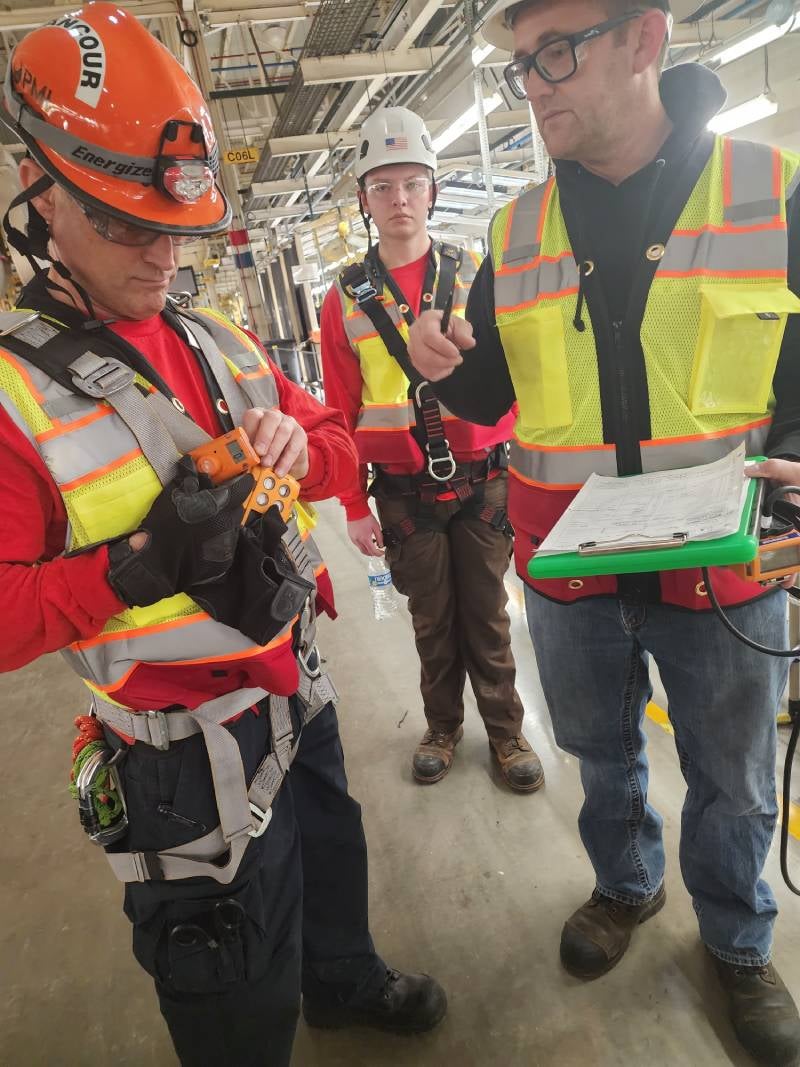
Before any entry occurs, RIT Services, LLC evaluates the specific confined space, the work being performed, and the hazards likely to be present. This includes reviewing entry and exit points, identifying retrieval anchor locations, and confirming atmospheric monitoring requirements. Rescue planning at this stage helps determine whether an entry rescue or a non-entry rescue approach is more appropriate for the space in question, and it shapes how equipment and personnel are positioned before work begins.
Once entry operations start, on-site rescue team readiness becomes the primary focus. This includes:
- Continuous atmospheric monitoring coordination
- Retrieval systems staged and ready for immediate use
- Communication systems linking entrants, attendants, and the rescue team
- Rescue equipment inspected and positioned according to the pre-entry plan
Confined space rescue standby for power plants depends on this level of preparation because conditions inside a boiler, vessel, or vault can change during the course of the work, sometimes without obvious warning signs.
Coordination with Plant Safety Teams and Contractors
Power plant projects frequently involve multiple parties working at once, including in-house safety staff, outage contractors, and specialty trades. Standby rescue personnel need to coordinate closely with each group to understand the entry schedule, the scope of work inside the space, and how communication will flow if an emergency response is needed.
RIT Services, LLC works to integrate with existing plant safety protocols rather than operate separately from them. This includes participating in pre-job briefings, confirming permit requirements with the entry supervisor, and establishing clear lines of communication with local emergency responders when additional resources may be needed. Industrial rescue standby services are most effective when they function as an extension of the plant's existing safety structure, not a standalone service layered on top of it.
Supporting OSHA Confined Space Rescue Requirements
OSHA's permit-required confined space standard requires employers to ensure that rescue services are available and capable of responding to entrants in a permit space. Meeting these requirements depends on a number of factors specific to the employer, the worksite, and the space itself, including how quickly a rescue team can respond, whether personnel are familiar with the specific hazards of that space, and whether equipment is appropriate for the retrieval method being used.
Confined space rescue standby for power plants can support these requirements by providing personnel who are positioned to respond without delay and who have reviewed the site-specific hazards in advance. That said, compliance is ultimately the employer's responsibility, and it depends on the full scope of the confined space program, not on standby coverage alone. Facilities should review their specific obligations under applicable OSHA standards and determine what level of rescue support fits their operations.
Training That Supports Long-Term Preparedness
Standby coverage addresses a specific project or entry, but many power plants also benefit from building internal rescue capability over time. Confined space rescue standby training can help plant personnel understand entry procedures, atmospheric monitoring, and rescue techniques, while broader industrial emergency response team training builds coordination skills that extend beyond confined space incidents to other plant emergencies.
Facilities that invest in both standby services and training tend to develop a more complete approach to confined space safety, since staff become more familiar with the equipment, procedures, and communication protocols used during an actual entry.
Frequently Asked Questions
What does confined space rescue standby for power plants typically include?
It generally includes pre-entry hazard assessments, on-site rescue personnel, atmospheric monitoring coordination, retrieval system readiness, and communication support throughout the entry operation.
Why can't a plant just rely on the local fire department for confined space emergencies?
Local emergency responders may not have immediate familiarity with the specific space, equipment, or hazards at a given facility, and response time can be a critical factor in a fast-developing confined space emergency. On-site standby personnel who have reviewed the space in advance can begin a response more quickly.
What is the difference between entry rescue and non-entry rescue?
Non-entry rescue involves retrieving an entrant from outside the space using a retrieval line and mechanical device, while entry rescue requires a trained rescuer to physically enter the space to reach the entrant. The appropriate method depends on the space configuration and the retrieval system in place.
Does using a standby rescue service guarantee OSHA compliance?
No. Compliance with OSHA confined space rescue requirements depends on multiple factors specific to the employer and the worksite, including training, equipment, and the overall confined space program. Standby services can support these efforts, but they don't automatically satisfy every requirement on their own.
When do power plants typically need confined space rescue standby services?
Common situations include planned outages, shutdowns, turnarounds, and maintenance projects that require entry into boilers, tanks, vessels, pits, or other restricted-access equipment.
Schedule a Consultation with RIT Services, LLC
Confined space work inside a power plant carries real risk, and preparation matters long before an entry permit is signed. RIT Services, LLC provides confined space rescue standby for power plants and industrial rescue standby services throughout the Southeast Industrial Corridor, working directly with plant safety teams to support safer entry operations from planning through completion.
If you're preparing for an upcoming outage, turnaround, or maintenance project that involves confined space entry, contact RIT Services, LLC to schedule a consultation and discuss what rescue standby coverage looks like for your facility. You can reach our team at 615-684-3274 or through our contact page to begin the conversation.